
7 Signs You May Be in a Karmic Relationships often serve as mirrors for our internal landscape, but some connections carry a weight that feels far older than the current lifetime. If you have ever felt an overwhelming, undeniable pull toward a person despite the chaos they bring into your life, you might be navigating the intense waters of a spiritual contract. Recognizing the 7 signs you may be in a karmic relationship is the first step toward self-liberation and growth. These unions are not designed to be conventional romances but are instead spiritual classrooms where the curriculum is often difficult, fast-paced, and transformative. By identifying these patterns, you can shift from a cycle of unconscious reactivity to one of conscious evolution, effectively turning a turbulent connection into a catalyst for profound personal healing.
The Core Essence of Karmic Connections

A karmic relationship is defined by a deep soul-level connection that exists to resolve past life debts or unconscious patterns. Unlike soulmates, who often bring a sense of ease and complementary energy, a karmic partner often acts as a mirror to your most shadowed parts. These relationships are marked by an immediate, almost jarring sense of familiarity, leading many to misinterpret the intensity as the start of a healthy long-term romance. However, the purpose is not long-term stability but the resolution of specific lessons that you have not yet mastered. You may feel an uncontrollable urge to stay, driven by the belief that you must fix, save, or understand the other person. Understanding these 7 signs you may be in a karmic relationship requires acknowledging that these connections are rarely built for long-term comfort but rather for short-term, high-impact growth.
7 Signs You May Be in a Karmic Relationship
To identify if your current bond is rooted in karma, consider these seven indicators that frequently define the experience. First, an immediate sense of familiarity is common, as if you have known them for eons, often leading to a fast-tracked emotional investment. Second, the relationship is characterized by volatile ups and downs, fluctuating between euphoric highs and soul-crushing lows. Third, you may feel an inexplicable sense of responsibility for their emotional well-being, as if their healing is your primary mission. Fourth, the relationship creates a repetition of negative patterns that you have faced in previous partners, yet this time, the lesson feels impossible to ignore. Fifth, the presence of these 7 signs you may be in a karmic relationship often coincides with a feeling of being trapped, where logic dictates leaving, but an invisible force prevents you from breaking the cycle. Sixth, the communication barrier is significant, where your words are met with defensiveness or misinterpretation, leading to constant circular arguments. Finally, the seventh sign is an acute internal exhaustion that lingers regardless of how much sleep you get, indicating that your soul is weary from the heavy work of transmuting these karmic energies.
Navigating the Emotional Turbulence
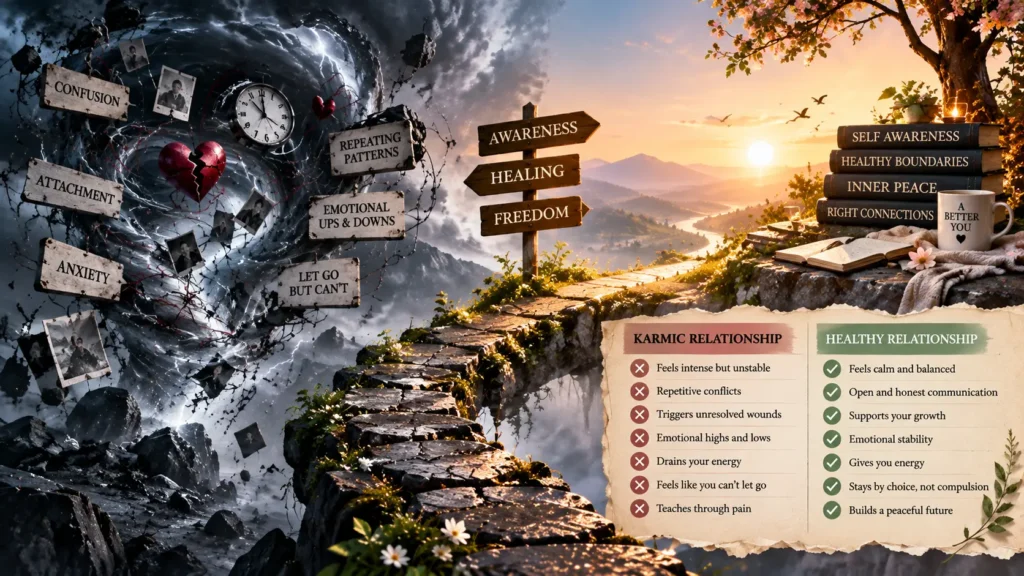
The emotional landscape of a karmic partnership is rarely static. Because the primary function of these bonds is to bring hidden traumas and subconscious triggers to the surface, you will likely encounter significant discomfort. The frustration you feel is not a failure of the relationship but a diagnostic tool for your own inner work. When you see the 7 signs you may be in a karmic relationship, you must pivot your focus toward self-inquiry. Instead of analyzing the flaws of your partner, analyze your own reactions.
What core wound is being triggered here? Is it a fear of abandonment, a need for external validation, or an inability to set firm boundaries? By shifting the focus to your internal state, you reclaim your agency. This process of introspection is essential because it detaches your self-worth from the erratic behavior of the karmic partner, allowing you to view the situation with the objectivity of a scientist observing an experiment.
Breaking Free from the Cycle
Moving past a karmic connection requires a deliberate choice to step out of the karmic loop. Many people struggle because they mistake the intensity of the bond for love. True love provides a safe harbor, whereas a karmic bond functions more like a stormy sea that forces you to become a better sailor. To move forward, you must initiate the process of detachment. This does not always mean immediate physical separation, though it often does, but it always requires mental and spiritual separation.
Establish boundaries that are non-negotiable. If the cycle is abusive or depleting, the boundary must involve removing your presence entirely. Understand that your growth is the ultimate goal, and once the lesson is integrated, the necessity for the relationship often dissolves naturally. You will know you have succeeded when the trigger no longer pulls you into a state of panic or despair, but is instead met with a calm, analytical curiosity.
The Role of Forgiveness and Self-Compassion
Forgiveness is the final stage of healing from a karmic bond. It is important to realize that forgiveness does not mean condoning harmful actions or inviting the person back into your life. Rather, it is the act of releasing the energetic tether that keeps you anchored to the past. When you acknowledge the 7 signs you may be in a karmic relationship, you realize that your partner has played a vital, albeit painful, role in your spiritual development. They were the mirror you needed to see your own unhealed spaces.
Cultivating self-compassion for the time you spent in the relationship is equally vital. Avoid berating yourself for staying too long or for not seeing the signs sooner. Every moment spent in the confusion was a moment spent gathering the data you needed to recognize the pattern. Self-love is the antidote to the karmic poison, and it is the foundation upon which you will build your future, healthier connections.
Frequently Asked Questions (FAQ)
Q: What are the best practices for 7 Signs You May Be in a Karmic Relationship?
The best practices include prioritizing self-reflection, establishing rigid emotional boundaries, and engaging in objective journaling. Use the intensity of the connection as a prompt to identify your own unaddressed trauma rather than using it as an excuse to analyze the other person.
Q: How to implement 7 Signs You May Be in a Karmic Relationship effectively in 2026?
Implement this knowledge by creating a roadmap for your personal evolution. In 2026, focus on using these signs as early warning systems. If you notice these 7 signs early in a new connection, prioritize your autonomy and emotional self-regulation immediately to avoid getting trapped in a repetitive, exhausting cycle.
Q: What common mistakes should you avoid with 7 Signs You May Be in a Karmic Relationship?
Avoid the common mistake of romanticizing the suffering as destiny. Another error is attempting to change or fix the partner; instead, recognize that the only person you have the power to change or fix is yourself. Lastly, do not stay in a toxic dynamic in the hope that it will eventually evolve into a peaceful soulmate relationship.
Q: Can a karmic relationship turn into a long-term healthy partnership?
While rare, a karmic relationship can evolve if both parties consciously work on their respective triggers and traumas. However, because these bonds are centered on specific lessons, they typically reach a natural conclusion once the lessons are learned. True compatibility usually arises after the karma is cleared.
Conclusion: 7 Signs You May Be in a Karmic Relationship
Understanding that you are in a karmic relationship is not a sentence of doom, but an invitation to profound personal growth. By paying close attention to these 7 signs you may be in a karmic relationship, you gain the ability to step back and observe the lessons that are being presented to you. These relationships are fast-paced, emotionally demanding, and often confusing, but they are also incredibly revealing. They force you to look at your deepest insecurities and take ownership of your healing process.
Once you integrate the lessons, set firm boundaries, and practice radical self-forgiveness, the cycle breaks, allowing you to move forward toward relationships that are built on mutual respect and genuine emotional safety rather than karmic obligation. Use this period of intensity to clear your internal slate, as the lessons you master now will save you from repeating the same cycles in the future.